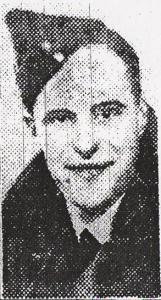
John BAGULEY
642862, Sergeant. b. 1919 d. 18th September 1940 (aged 21).
One of the first casualties from Clayton in World War II, John was a Sergeant in the Royal Air Force, a unit that had developed beyond all recognition since the end of the last global conflict in 1918. The R.A.F. was first formed as an individual entity in 1918 when it separated from its previous incarnations as the Royal Flying Corps (army based) and Royal Naval Air Service (navy based) to become a single service with its own ranking system and awards.
During the period of 1914-18 aircraft technology was remarkably simple in comparison to that of its other army counterparts, with the airplane bodies being constructed mainly of wood and fabric, making it not viable to use on a mass scale. The last year or so of the Great War was when most aerial advances took place, establishing the airplane as a hot prospect for future developments. This meant that in the inter-war years, a large amount of financing was spent on aircraft development, so at the start of World War II technology had reached a level where aircraft had an armament as good as any land vehicle of a similar purpose, and an arsenal of weapons to match. With the capability of the heavier aircraft, such as bombers, to travel long distances it meant a whole new weapon was ready for exploiting. This was an unfortunate fact the Axis powers knew very well and were poised to use. In essence the 1939-45 war was the first global scale war where civilians were afflicted just as badly as the troops away at the front, with both sides dropping millions of tons of bombs on each other’s doorsteps.
John Baguley volunteered for active service in May 1939 as many men did at the time, as if conscription was introduced they would be able to serve where they wished. He was not alone in doing this, as he went with his friend Joe Wilkinson, who was also from the village. Eight known Claytonians volunteered during the period building up to the war: six into the Territorial Army, with John and Joe joining the R.A.F. Both were sent to be trained with the thousands of other raw recruits, and John specialised as a radio operator. Joe was separated at this time and survived to forge a new life for himself at the end of the conflict. It would have been during this training that John met the rest of his crewmates who would eventually serve with him in 77 Squadron, as it was normal policy for crews to train together before being sent on their first combat operations.
When John and his crew joined 77 Squadron, who were based at Driffield, they found they were to be flying Armstrong-Whitworth Whiteley bombers. These machines were known as ‘flying pencils’ because of their long and almost stretched appearance, but were some of the best bombers in the R.A.F. at that time: the Whiteley had the privilege of being the first bomber used on night operations in WWII.

John was the Radio Operator of Whiteley number P4992, along with Pilot Officer Ronald Percy Brayne (Pilot), a 20-year-old from Oxford; Pilot Officer Walter Morrison Douglas, 26 from Vancouver; Sergeant John Alan Raper aged 20 from Richmond, Surrey and Sergeant Dennis Victor Hughes also 20, from Shrewsbury.
That night casualties were light for the R.A.F. with only two crews (including John’s) being lost, but 77 Squadron lost 113 personnel either killed or taken prisoner over the first fifteen months of the war – a full 27 planes worth of men.
On the night of his death John’s crew were shot down as they left their bombing run on the city of Antwerp, Belgium. The accident report states that their plane crashed into the sea off the Belgian Coast with all the crew aboard, except for Douglas and Hughes. These two are buried in Schoonselhof Cemetery. John and the rest of the crew are described as ‘lost with the aircraft’ and are remembered on the Runnymead Memorial.
A record of the fatal crash can be found here. A record of the crash is held in National Archive at Kew and whose contents would likely describe what happened to P4992 that night.
On an earlier mission their aircraft was involved in a forced landing at Flamborough Head, described here.
John was an old boy of Grange High School and the son of Harold and Dorinda Baguley of 21, Fieldway Clayton.
The memory of Mrs Baguley receiving her son’s ‘Missing Presumed Killed’ telegram still haunts Rene Sutcliffe* today, as she still lives in the village and throughout the war was one of the workers in the village post office. Part of her job entailed delivering telegrams to people, although she asserts that for the vast majority these were positive messages as opposed to negative ones. She remembers that within a couple of weeks of commencing her post she had to take the telegram to Fieldway, and when approaching the doorway Mrs Baguley let out a piercing scream as she was looking out of one of the front windows of the house. Rene delivered the telegram and left. John had younger sisters who grew up, married and left the village shortly after the end of the conflict.
Malcolm Baguley, one of John’s second cousins who still lives in Clayton remembers that when he was a boy early on in the war a bomber flew low over the village – his parents told him at the time that it was John come to show everyone what he was doing. Whether or not it was John, this incident has remained in Malcolm’s memory for the better part of seventy years.
John is commemorated on the Runnymede Memorial, in Surrey, often referred to as the Air Forces Memorial to those who have died with no known grave.
*Since this research was undertaken Rene Sutcliffe has sadly died.
 Clayton Remembers