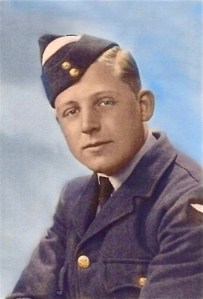
Douglas Briggs BIRBECK
1685263, Sergeant. b. 11th June 1922 d. 15th March 1944 (aged 21).
Douglas Briggs Birbeck was born on 11th June 1922 at 59 Clayton Lane, a short walk up the hill from the parish church. Douglas was the only child of Leonard and Florrie Birbeck (nee Smith) who were married on 7th September 1921, at St. John’s the Baptist Church, Clayton Lane, Clayton and where Douglas lived until his teens.
Douglas’ grandparents on his mothers side were Vincent Smith and Sarah Smith (nee Briggs), and on his fathers side were William Birbeck and Martha Birbeck (nee Breese) from Saltaire. Vincent’s occupation is listed as a Spindler, William’s occupation is listed as a wool sorter.
The 1901 census shows William, Martha and young Leonard, aged 8, living on Hartington Terrace in Lidget Green, about 2 miles from Clayton.
By the time of the 1911 census William had died and Martha and the children were living at 41 Stanmore Place in Lidget Green. Leonard, now 18 is listed as working as a warehouseman in cotton goods. Martha passed away in 1912.
By the time of the 1921 census Leonard is now 28 and living with his elder sister Margaret Birbeck in Delaware St. off Manchester Road in Bradford, both his parents are deceased.
Leonard is presumably courting Florrie Smith as they were married on 7th September 1922 at St. John’s the Baptist Church, Clayton Lane, Clayton.
The 1934 electoral register shows Leonard and Florrie, and presumably Douglas, living with Florrie’s parents Vincent and Sarah at 93 Clayton Lane, Clayton.
By the time of the 1939 register Leonard, Florrie and her father Vincent Smith had moved from Clayton to open a newsagents and tobacconists on 47 St. John’s Rd, Waterloo, Crosby, Liverpool. We don’t know when the Birbeck family moved but do know it is between 1934 and 1939, when Douglas would have been 13 to 17 years old.
At some point Douglas joined the Royal Airforce Voluntary Reserve probably when he was 18 or 19. Douglas was assigned to 49 Squadron flying Lancaster bombers in raids across Europe. Douglas was one of the crew of ND474 that took part in a raid to Stuttgart on the night of the 15/ 16 March 1944, a campaign known as The Battle for Berlin.
Having completed the raid on Stuttgart and commenced their journey home the crew of ND474 were engaged by a Luftwaffe night fighter. Having sustained serious damage the records indicate they changed direction and headed south for neutral Switzerland. Sadly, the Lancaster Bomber crashed some 16km short of the Swiss border in the village of Bolstern, Southern Germany.
The crash was heard by local farmers, who ran into the burning bomber and pulled the crew out. A set of rosary beads was found in one of the crews pockets, so it was assumed that the crew were Christian. The bodies were given a Christian burial in the village church. The church records show that it was decided that prayers would be said for the ‘English flyers’ and that flowers would be placed on the graves regularly. Once the Germany military learned of the crash, they quickly moved the destroyed bomber from the village and warned the villages not to place flowers on the graves of the so called enemy. Flowers continued to be placed, despite the warnings of the SS.
In 1948, the War Graves Commission exhumed the bodies and moved them to Durnbach War Cemetery, where the crew lay to do this day.
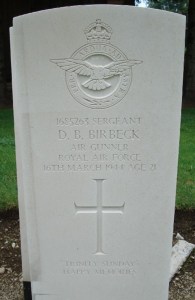


Bolstern, Germany
In 2014, relatives of the crew made a trip to Bolstern and erected a memorial in honour of the crew. The memorial stands in the area where the Lancaster is believed to have crashed. The memorial honours the crew for their sacrifice and thanks the villagers of Bolstern, who during a time of war, treated the crew with respect and dignity.
Although not listed on the Clayton Village war memorial or the memorial in church there is a brass memorial vase that stands on the war memorial in St. John’s Church.
We believe this was commissioned by Douglas’s maternal Grandparents Vincent and Sarah. Douglas’s middle name is Briggs, his grandmother’s maiden name.


In 1955 Leonard and Florrie retired to Lytham St Annes. Leonard Birbeck died in 1961 and Florrie Birbeck died in 1970. Vincent Smith died in 1964 and Sarah Smith in 1941. William Birbeck died in 1904 and Martha Birbeck in 1912.
Further information regarding ND474 can be found at this link: https://www.rememberingnd474.co.uk/
The 49 Squadron Association website can be found here:
https://www.49squadron.co.uk/home
Thanks to Louise Turner-Hoole for the following article:
The fatal crash 15th March 1944
This is the carefully researched story of ND474 and her seven crew members:
Lancaster ND474 – T-Tare – The Crew – 15th March 1944
- Sgt Douglas Briggs Birbeck – Upper Gunner – Age 22 years,
- Sgt Ronald Hoole – Flight Engineer – Age 20 years,
- Sgt Terrance Colon McEneaney – Navigator – 22 years,
- Sgt John Grenfell Wise – Rear Gunner – 19 years,
- Sgt William Hardy – Wireless Operator – 22 years,
- Pilot Officer – Thomas William Waugh – 22 years,
- Flying Officer – John Joseph Knowles – Bomb Aimer – 23 years
The Mission – On the evening of the 15th of March 1944, having flown just eight missions, the Lancaster ND474 was being prepared by her ground crew and together with 17 other aircraft, she was scheduled to leave RAF Fiskerton that evening on a raid to the railway heads in Stuttgart.
In the afternoon of the same day, the seven names of the new crew were listed on the operations board, and they were then required to attend a pre-mission briefing. This was to be their first mission together, they already knew that they would have to complete 30 missions before being released from operations and that as an inexperienced crew; their first five missions would be the most dangerous. After 2 years in training a new crew would normally have been sent on a less dangerous mission but with heavy losses amongst the bomber command crews during the early part of 1944, this new crew was sent deep into enemy territory.
Despite the terrible odds stacked against them, the young crew of ND 474 prepared to leave for Stuttgart. They had a meal together and collected their flying suits from the locker rooms. As the light faded ND474 rumbled down the runway laden with its load of high explosive and incendiary bombs. Together with seventeen other Lancaster’s from 49 Squadron, ND 474 took off from RAF Fiskerton at 19:05 and was the third aircraft to leave the airfield. The main raid to Stuttgart consisted of 863 aircraft – 617 Lancasters, 230 Halifaxes, 16 Mosquitos – all from different squadrons based in and around Lincolnshire.
At 20:05, five minutes after the formation of bombers flew across the coast of France, the German fighter controller had been altered and had split his forces into two parts. The bomber force flew over France nearly as far as the Swiss frontier before turning north-east to approach Stuttgart. This delayed the German fighters contacting the bomber stream but, when the German fighters did arrive, just before the target was reached, the usual fierce combats ensued.
At 23.15 Hrs over Bolstern, southwest of Salgau, at height of 6,200 metres, ND474 was intercepted by a German night fighter. Having completed their mission, but now on fire the crew realised that their Lancaster aircraft would not be able to make the journey home to Fiskerton. The crew of ND 474 turned south towards neutral Switzerland, this being a pre-planned escape strategy in the event the aircraft was unable to make it home. Just eighteen minutes flying time from the Swiss border, ND 474 crashed into a field near the village of Bolstern and all the crew were sadly killed. The eldest crew member was only 23 years old and the youngest just 19 years old, they paid the ultimate price for our freedom today.
The crash was heard by local farmers, who ran towards the burning bomber to help them but sadly, there was nothing they could do. A set of rosary beads was found in one of the crew members pockets, so it was assumed that the crew were Christian. Despite the high risk of being shot by the German soldiers, the villagers of Bolstern gave the crew a Christian burial in their village church. This was an act of great kindness and one which the relatives group continue to be indebted and most grateful. The church records show that it was decided that prayers would be said for the ‘English flyers’ and that flowers would be placed on the graves regularly.
Once the Germany military learned of the crash, they quickly moved the destroyed bomber from the village and warned the villages not to place flowers on the graves of the so-called enemy. Flowers continued to be placed, despite the warnings from the SS. In 1948, the War Graves Commission exhumed the bodies and moved them to Durnbach War Cemetery, where the crew still lay to this day.
In 2014, relatives of the crew made a trip to Germany and together with the villagers of Bolstern, they erected a memorial in honour of the crew. The memorial stands in the area where the Lancaster is believed to have crashed. The memorial honours the crew for their sacrifice and give thanks to the villagers of Bolstern, who during a time of war, treated the crew with respect and dignity.
Since March 2014, the relatives group continues to be in contact with the villagers of Bolstern and their church, where they still continue to say daily prayers for our relatives. Each remembrance Sunday and on the anniversary of the loss of the crew, the villages hold a service at the memorial in the village.
Images courtesy of Louise Turner-Hoole
 Clayton Remembers