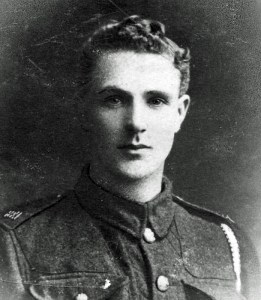
Lawrence BRIGGS
42967, Lance Corporal, b. 1889, Clayton d. Fri. 22nd March 1918 (aged 29).
The elder brother of Albert Briggs, Lawrence had enlisted into a different regiment slightly later than his younger brother. Lawrence was the son of Timothy and Frances Anne Briggs.
The 1901 census shows them living at 11 Virginia St. Clayton, Lawrence is shown aged 12 and is employed as a clerk at a wool merchants.
Lawrence married Mary Jane Silverwood on 3rd June 1916 at Allerton Congregational Church and his occupation is shown as a Driver R F A.
Lawrence trained and was sent to France with ‘A’ Company of the 9th Battalion, (Kings Own) Yorkshire light Infantry or the K.O.Y.L.I’s (pronounced ‘koylees’ for short). He lasted longer than his brother did as he was not involved in the first day of the Somme Offensive, but instead fell victim to the German Spring Offensive of 1918, a campaign that nearly cost the Allies the war.
This campaign was begun on Thursday 21st March 1918 when vast numbers of German troops began to pour out of their trenches towards the British lines. The British were totally unprepared for this and their front lines were quickly overwhelmed by the rapidly advancing German troops. A strategic withdrawal had to be made and the British army suddenly found that it was being overrun with large numbers of casualties and prisoners of war being inflicted on them. Throughout the last week of March and the beginning of April 1918, the Germans kept up their advance, pushing the Allies back and back while the British lines were somewhat in disarray. This was the period of the most movement throughout the entire Great War, and cost the lives of tens, if not hundreds of thousands of Allied troops.
Lawrence was caught up in these movements and was killed whilst trying to withdraw from the front, as he died on the second day of the attacks. Because of the sheer volume of troops moving around at this time, many soldiers became separated from their own units and were posted missing in action. Some returned having just got lost, some it was later discovered, were prisoners of war, but the time it took for these men to be processed and their families/units informed was up to several months. The worst possible scenario, as was Lawrence’s case, was that they were never seen again, presumably having being killed during the advance, and the bodies were never recovered. In essence they had just ‘disappeared’.
Lawrence is commemorated on the Pozieres Memorial for the missing near the Somme.
Mary Jane Briggs remarried after Lawrences death and as Mary Jane Johnson lived in Thornbury, Bradford.
 Clayton Remembers