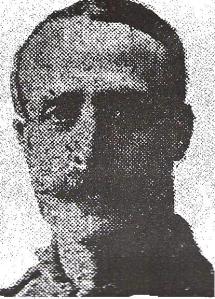
Dracup HINDLE
99844, Bombardier. b. 1876, Great Horton d. Sun. 11th November 1917 (aged 41).
Another of the ‘old’ claytonians to die in France, Dracup had joined up in early 1915 when he was aged 38, the upper age limit that the army would accept soldiers into the Royal Garrison Artillery.
Dracup had lived at 67, Oakleigh Road for over twenty years with his wife, Laura Maud and their son, Harry Dracup Hindle. In 1901 his occupation in the census was given as ‘Hosiery Traveller’ and very little is known of his history from then until 1914 when he is recorded as being married and in Clayton
His parents, Martha and Henry Hindle still lived in Dracup’s native Great Horton and all the family had close connections with the Great Horton Wesleyan Chapel where he was the leader of the Sunday school. It is very likely that the family had been in Great Horton for a long time, as the name Dracup is one closely intertwined with the history of the parish. The Dracup family were one of the major mill owning families throughout the 19th and early 20th centuries, and it is highly likely that the Hindle’s were connected by blood in some way or other. As well as being part of the community in Great Horton, he also had many friends in Denholme as he made the trek daily to and from the village to get to his work, Farnish Crabtree and Co. on Well Street where he had worked for many years.
As a Bombardier, Dracup’s job would have been to organise a gun crew (consisting of himself and several gunners) and his unit was known as the 124th Siege Battery, meaning that the guns were of a larger calibre than some of the normal field guns. It is also likely that he was attached to the West Riding Division, as his place of burial is dedicated, for the most part, to soldiers who died whilst serving with this group of men.
Having served for over two years, his death came quickly and unexpectedly as his officer wrote home to Mrs Hindle explaining that ‘he was killed instantaneously as the result of a shell exploding right next to his battery’. He was buried the same day in Talana Farm Cemetery, near Boesinghe, Ypres. His gravestone is inscribed ‘Thy will be done’.
 Clayton Remembers