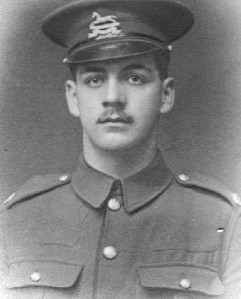
Norman RANDLE
16/1212, Private. b. 1893, Knaresborough d. Thu. 25th April 1918 (aged 25).
Again, the 16- prefix to Norman’s army number gives a good indication as to his time in the army: he was another of the hapless Bradford Pals who suffered so greatly on 1st July 1916. Having joined up with his fellow Clayton men, Norman trained with the Pals and spent the first part of his time serving with them until the summer of 1916. He was one of the lucky ones however, as he was hit by shrapnel on the 1st July and became one of the ‘groaning masses’ that covered the battlefield.
In the Bradford Press shortly after the Somme attack a soldier from Norman’s unit is quoted as saying that the Pals “went over the top as happy as school boys”. It should be noted that most of these soldiers were only just older than schoolboys – many had come straight from school before even finding work.
Norman, as previously stated was one of the lucky who returned with a ‘Blighty’, and at the end of his convalescence was sent back to join the 2nd West Yorkshire’s whom he served with until he was wounded for a second time in August 1917 (see Bertie Richardson’s record for details). After a further stint back in Britain, Norman returned for a final tour of duty, this time with a promotion to Lance Corporal but still as a member of the 2nd West Yorkshire’s. He died on the same day as Prince Pullan in April 1918, although this time in the Somme sector of the front. This death proves that the German attack was over the entire line at once, not just at its weakest points.
The 1901 census shows Norman aged 7 living at 5 Tenter Hill with his father John, aged 64, and his mother Ellen aged 34 with 3 siblings. 10 years later in 1911 the census lists Norman living at 11 Back Lane, Clayton and shows his eldest siblings as step brother and step sister. It is presumed that his father has died.
Norman had grown up on Wolseley Street, Clayton with his parents John and Ellen, and his older brother John W. Randle who had recently moved to 51, Havelock Street, Great Horton. Like Prince Pullan’s family, Norman’s continued to appeal for information until long after the Armistice had been declared.
Norman is commemorated on the Poziers Memorial, Poziers, Somme, France.
 Clayton Remembers