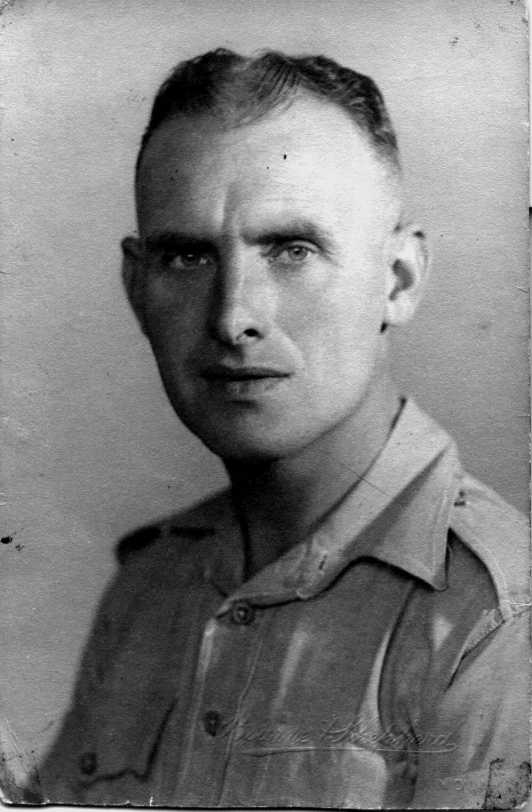
Arthur RYCROFT
2124106, Signalman. b. 1907, Belfast. d. 4th March 1946 (aged 38).
Arthur was the son of William and Annie of West Bowling and the husband of Mary Hannah Rycroft of 19 Ash Mount, Lidget Green.
In 1911 census shows Arthur, aged 3, was with his parents and sister, Iris at Clement Street, Bradford. The 1939 census shows him married to Mary Hannah, living at their home on Ashmount and working as a Wool Warehouseman. Arthur was also at this time a volunteer fireman with Bradford Auxiliary Fireservice. The 1939 census shows another occupant at 19 Ashmount but the record is closed.
We are not sure when Arthur signed up, but his war record shows he was with the Royal Signal Corps 19th Air Formation Signals. The 19th Air Formation Signals was formed in Kirkburton, Huddersfield in November 1943.
19 Air Formation Signal Regiment was formed at Kirkburton, Huddersfield on 17th October 1943. During the following year the Regiment was mobilized and sailed to India for overseas service in November 1944. Its first operational task was to provide communications for HQ Combat Cargo Task Force, an integrated RAF/USAF force air-dropping supplies to the ground forces in Burma. The Regiment was based at Comilla in Bengal, with Companies in the Chittagong and Imphal areas supporting the Chindits and other forces in the Burma Campaign.
As part of the 19th Air Formation Signals of the Royal Signal Corps, Arthur’s job would be to ensure all communications flowed smoothly between different branches of the R.A.F. (using telephone, morse and cipher) and to deliver messages as a dispatch rider if necessary.
Unfortunately, no exact details of Arthurs service record can be found and it would be speculation to be any more specific as to his role in the conflict.
It is almost definite that he would have been serving overseas when he received the wounds that would eventually cause his death. His photo shows him hot climate uniform.
He returned to Britain and to St. Luke’s Hospital on Little Horton Lane. There he died on the 4th March 1946, nearly a year after the conflict’s end in Europe but only 6 months after VJ day for Victory In Japan and the Burma Campaign.
By this time in 1946, people were wanting to get on with their everyday lives and put the war behind them. Soldiers were returning home not wanting to talk of their experiences, the media had grown weary of printing pages upon pages of photos of wounded and dying men and the Bradford Telegraph & Argus had stopped having a separate servicemen’s column. Arthur’s death notice appeared as just a small obituary in one corner of a page. What is telling though, is the final sentence after a very plain description of his family and the details of his funeral in Scholemoor Cemetery: “Friends are to meet after at Scholemoor Crematorium, but please no mourning.”
The photo of Arthur is by courtesy of the family and was sourced via a family tree in Ancestry.co.uk
 Clayton Remembers