
Kenneth TIDSWELL
14303917, Trooper. b. 1924, Bradford d. 14th August 1944 (aged 20).
The son of a long-standing Clayton family, Kenneth’s grandfather was the well-known hangman Albert Pierrepoint. Kenneth was the son of Riley and Annie Tidswell (nee Pierrepoint). The 1939 register shows Riley, Annie and son Kenneth living at 13 Back Fold, Clayton, Riley is a foreman in a tool makers.
Kenneth joined the 5th Battalion King’s Own Royal Regiment (Lancaster) Royal Armoured Corps. After his training and became part of a tank crew serving in the Normandy Landings, and the Allies’ first tentative steps back into Europe.
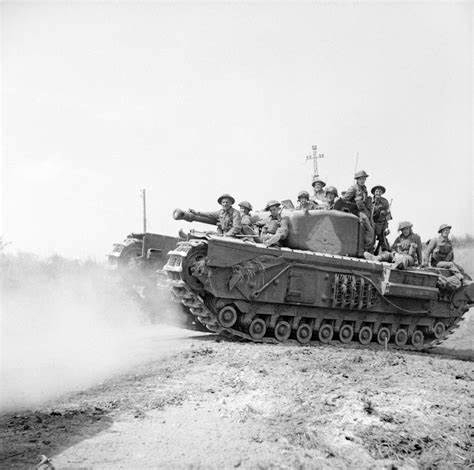
The 5th Battalion had seen action in Dunkirk in 1940, long before Kenneth was conscripted and by the time he was serving, the Battalion was known as the 107th Regiment, Royal Armoured Corps. This dual title emerged, because with the advancement of tank warfare during the inter-war years there was a need for many more armoured groups and so several infantry battalions had been ‘converted’ into tank units. By this time Kenneth’s unit were fighting in Churchill tanks, one of the heavy tanks in use by the army at the time which had a crew of 5, usually 4 ordinary-rank soldiers under the command of an officer or experienced sergeant.
As the army tried to push its way into France it took a severe beating for the first few months. The 107th were involved in the Battle of Caen, at Hill 112 near Esquay, south west of the City and following heavy fighting at Grimbosq and Brieux on the 7th and 8th August crossed the River Orne and concentrated to the west of Falaise for reorganisation.
It is possible to ‘decipher’ which units were passing through the area during which periods, if the records of commemoration are looked at in enough detail. For example, Kenneth’s unit has only nine burials there – all of them date to between 8th August and 14th August, probably meaning that after this point the 5th battalion had moved further up the line. From this it is possible to work out at least part of the tank crew who were present with Kenneth when he died. Six of the ten casualties died on the 8th or 9th of August, and were probably one crew with one extra man possibly dying of wounds (two officers are present so might account for this) whilst the remaining four (including Kenneth) died on the 14th. The men who died on the 14th were:
– Trooper Kenneth Tidswell (aged 20, from Clayton Bradford)
– Lt. John Alvin Fothergill (from Colchester)
– Trooper George Sharratt (aged 24 from Amble, Northumberland)
– Trooper John Thomas Shepherd (aged 20, from Bletchley, Bucks).
The identity of the fifth crew member remains a mystery – he might even not have been with them at the time as he could have been wounded in some previous engagement (single crew member reinforcements at this point in the advance were a commodity for tank crews). The more likely possibility however, is that he was wounded and survived to tell the tale, or alternatively survived the initial few days before being buried near a field hospital on the way back towards the coast. A final and more grisly alternative is that their fifth crewman was unidentifiable when their remains were interred and he is now one of the 140 unidentified servicemen buried within the cemetery. Unfortunately, this is one puzzle that may never be solved but at least Kenneth’s memory can be linked now with those that fell at the same time.
Most of the burials in July are from the time when the Allies recaptured Caen but afterwards sporadic fighting continued in the surrounding countryside for many weeks, and this is where Kenneth met his end.
Kenneth’s final resting place bears stark testimony to this as there are no less than 2170 burials in the Banneville-le-Campagne War Cemetery, all of which date between late July and August 1944.
Banneville-le-Campagne is about 10 kilometres east of Caen. Kenneths headstone is engraved with the inscription “Alone, yes not alone”.

Courtesy of King’s Own Royal Regimental Museum
 Clayton Remembers