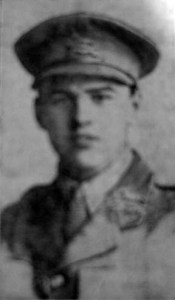
Harry Gordon WOOD
Acting Lieutenant. b. 1895, Clayton d. Thu. 7th June 1917 (aged 22).
One of the young officers to fall from the village, Harry had been in the army for just over a year and a half. He had gained promotion to first Lieutenant relatively quickly for one so young, as officers’ life spans on the Western Front were even shorter than those of their men. At the time he was serving with the 11th West Yorkshire’s.
It had always been military principal for the enemy to take out officers first during any engagement, as it was seen that they were the ones that knew what their men should be doing. Remove that threat, and the common soldier should, theoretically, not be able to cope by themselves, the old saying went, and both Allied and Axis troops stuck to this.
Consequently, very few officers survived the first engagements of the war without being killed or wounded and the tactic was quickly adopted that officers when going over the top, should dress in a similar way to their men.
One of the most common identifying features on an officer was his ‘pips’ or rank insignia that were on the lower sleeve of both arms. This was changed unofficially in battle so that pips were worn on the shoulder making them unrecognisable from a distance and hence saving an officer’s life. It was such a valuable lesson learned in the Great War, that before the start of the Second World War, the Army had adopted it as official policy for officers to wear pips on their shoulders permanently.
Harry managed to survive through the Somme without major injury but instead was killed nearly a year later in the opening stages of the Third Battle of Ypres. He was the son of Harry and Mary Wood.
Since this research was completed in 2005 Nick Hooper has researched Harry Gordon Wood:
Lieutenant 11th (Service) Battalion West
Yorkshire Regiment. 16/1075
Gordon Wood was the second son of Harry Wood and Mary Ellen (nee Smith), born in Clayton in 1895.
Harry was from Halifax and ran the family company of William Wood and Son, Wool Merchants, of Halifax and Bradford, founded by his grandfather. In 1890 he married Mary Ellen Smith, the daughter of a railway worker, from Bradford. They had three children, a daughter and two sons. The brothers Leslie and Gordon both started at the Bradford Grammar School in 1905. Leslie was the academically more successful of the two, coming first in his form in two of his three years at the School. He left in 1908. Gordon stayed on until July 1910.
In his final year, in 4th Modern upper, he finished around the middle of the form order in most subjects apart from Geography in which he came second. The brothers both went to work in their mid teens as assistant wool merchants for their father, although they were not formally bound as apprentices. In its obituary the Shipley Express noted that Gordon was a ‘young man of genial gentlemanly disposition and was looked upon as having a promising career before him.’ He was also an ‘enthusiastic member’ of the Clayton Musical and Dramatic Society.
When war broke out both brothers volunteered for the Bradford Pals battalion and appeared in the list of the ‘First Thousand’ published by the Bradford Daily Telegraph at the start of November 1914. Gordon had enlisted on 19th October, at the age of nineteen years 289 days. He was allotted the service number 1075. After two months’ experience as a private soldier, in early January Gordon submitted an application for an officer’s commission, which was granted on 25th February. A day later his elder brother was commissioned into the 18th Battalion, 2nd Bradford Pals. Gordon was appointed to the 3rd Battalion West Yorkshire Regiment, and then served
in Britain with the Training Reserve.
His medical record shows that he was 5’ 8” tall and weighed 125 lbs. His physical development was good, his hair was black and his eyes brown. In December 1916 he was promoted to Lieutenant, then in January 1917 he was transferred to the Base at Etaples in
France. He was subsequently attached to the 11th Battalion West Yorkshire Regiment and joined them near Ypres at the start of May.
At 3.10 am on 7th June 1917 the Battle of Messines opened with the detonation of 600 tons of explosives divided between nineteen mines which had been tunneled under the German front line. The explosion was heard as far away as Dublin. The 11/West Yorkshire attack at Hill 60 ‘proceeded entirely according to plan’, in the words of the Battalion War Diary. By 4.30 am the first objective had been taken, and by 5 am the battalion was consolidating the second objective. Despite the surprise that had been achieved, officer casualties were described as ‘very heavy’; over three days in the line the battalion lost six officers killed, nine wounded, and one was ‘wounded and missing believed killed’. This latter was Gordon Wood. He was initially reported dead, and 7th June is the date on his gravestone and in the records of the Commonwealth War Graves Commission. However, Wood had actually been taken to the 69th Brigade’s Field Ambulance and it was there that he died of his wounds on 9th June.
His parents received a telegram bearing this news on 11th June, the day they were to have accompanied their elder son Leslie to London where he was to be invested with the Military Cross for conspicuous bravery. Gordon was buried in Railway Dugouts Burial Ground (Transport Farm). He is also on the War Memorial of St. John’s Parish Church, Clayton. Leslie survived the war.
Courtesy of Nick Hooper. https://www.bradfordgrammar.com/wp-content/uploads/2017/04/1917-June-9-Wood-HG-116.pdf
 Clayton Remembers